Header photo (detail) courtesy Michael Eudenbach

Monday, June 3, 2013

Whaleboat Roundup .1


Rocking the Boat


She's a beauty!


Geoff McKonly keeps the project going during a break


Such grace

Ready to launch


Splashed!


Photos courtesy Rocking the Boat

Gannon and Benjamon


The lofting


Plastic bags were used in place of steam box so that the plank could be "whomped" in place.


Closer look at the frames. The top of the frame is fit into a chamfer on the underside of the inwales.


Framing installed


We laid down a coat of oil-based primer throughout the hull before installing any of the ceiling.
(The ceiling is the planks you see here being installed atop the frames-ed)


Whaleboat is primed and ready to paint!


Nat and the whaleboat

Above photos courtesy Gannon & Benjamin Marine Railway


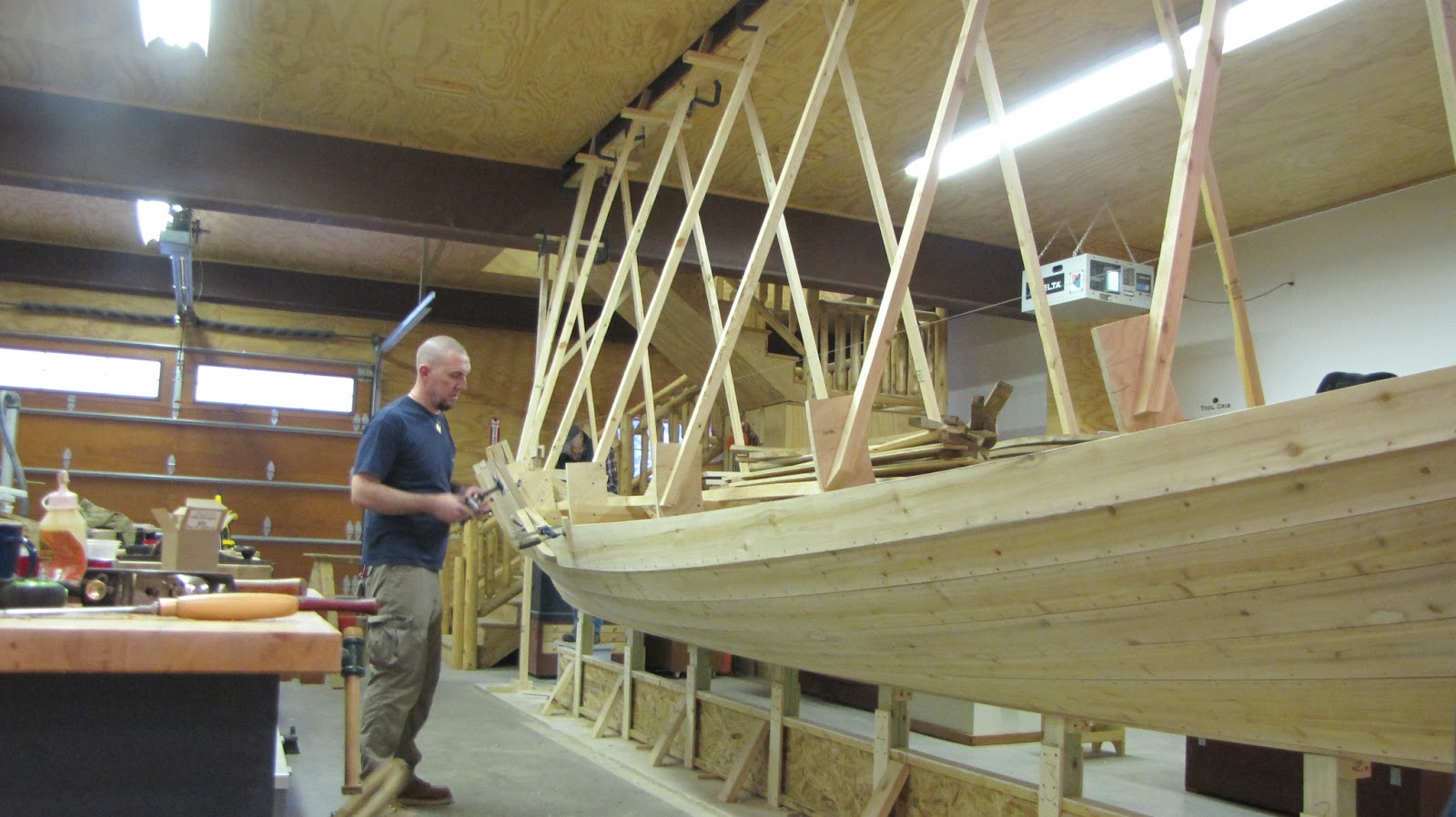
With  the July 21st deadline for the launch of the CW Morgan, the various builders of her whaleboats are in full swing to finish. I'll be catching us up on the progress of the boats over the next few weeks. As you can see above, at least one has already splashed, the Rocking the Boat build. My heartiest congratulations to the young volunteers and their instructors for reaching this milestone. Also, the work at Gannon and Benjamin is nearing completion.
The two boats being built at Independence Seaport will go in the water June 8, and I plan to be there for their splash, so stay tuned. (You can also follow the progress with almost daily reports by Charles Bernstein on the WoW blog)
It has been decided that each build will complete their spars and rigging independently, with the exception of RTB, whose rig will be done at Workshop on the Water. I know that Graham McKay of Lowell's Boat Shop was in Philadephia at the Worksop recently building the spars for their boat.
It's my understanding that the completed boats will travel to Mystic to be aboard the CW for her splash and then return to their respective homes for awhile, but ship on the Morgan for her cruise to the New Bedford Whaling Museum in 2014.

As mentioned earlier, I'll be doing a (virtual) tour of the various yards to catch up on their progress. Come along.


Copyright Thomas Armstrong   


Monday, January 28, 2013

Great Lakes Boatbuilding School joins the project


CW Morgan at Mystic with a whaleboat in the foreground.


 A raised lofting table was constructed in the school's loft for the whaleboat.


Lofting details


Deciding if the lines are fair


Freshly steamed stem being inserted into the bending jig and bent to shape using a compression strap.


Stem secured in bending jig. Note the custom fabricated compression strap attached to the jig at one end and the handle at the other end.


Chopping the rabbet into the stem


Construction of the backbone begins


Building jig is erected, backbone assembled, and molds are secured in place.


Garboard plank hung along with a lapped-straked plank above it on the starboard side. The following planks will be done with carvel batten-seams. 


Bottom two planks on the port side completed. Note the notches in the molds for the batten seams that were laid out during the lining off process.


The whaleboat seen amongst all the other developing projects in the shop.


First lapstrake plank below the sheer being hung.


Students slowly bend the a frame over the jig using a compression strap.


Steamed frames are drying in bending jig as planking work continues.


With the completion of planking, work shifts to installation of the pre-bent frames.


 Clamping the frames in place.


All images courtesy Great Lakes Boatbuilding School


"The Great Lakes Boat Building School (GLBBS) is proud, honored, and excited to have a role in the Mystic Seaport museum’s restoration of the Charles W. Morgan."
So begins the glbbs short dissertation on the project, with a history of the Morgan, a nicely done description of the whaleboat in general and the Beetle craft in particular and  a statement of their expectations and the merit of taking on such a project. As with most of the participants in the project, Great Lakes is using the build as a learning experience for their students. Indeed, their website outlines in great detail what the students will be learning. Here is a taste of that:


"First and foremost, in the building of this whaleboat students will learn team work. It has been said, “To work with someone is to know him; to build a boat with him is to know him well.“ And so it goes at GLBBS.
The process begins with the preliminary work being done by second-year students, while the first-year students are being introduced to classic woodworking skills, which involves building their toolboxes and being introduced to the fundamentals of lofting. Second-year students, having learned the required lofting skills in their first year, will loft the whaleboat to establish its full-size lines, which then will be used to form the necessary references and patterns required for accurately building this boat to the Beetle design.
Second-year students will continue on with the next step, which is using the lofting lines to make the molds representing the hull shape, then setting the molds up in a building jig. The building jig is designed for building the whale boat right-side up, and also to allow plenty of height underneath for working on the bottom of the whaleboat.
Once the second-year students have completed the building jig, the actual boat construction begins with the building of the backbone. They will build a keel, stem, and sternpost. In this process, they will gain more experience in constructing a bending jig, as well as the steam bending process involved in bending the stem and sternpost. When the stem and stern post have been bent to shape, students will learn how to layout and carve the rabbet into the stem and sternpost and assemble them together on the building jig to form the backbone of the whaleboat."

Suffice it to say, there's a lot more.

My sincere thanks to Kevin Pagliuca at Great Lakes for his assistance.

Thursday, January 3, 2013

The Apprenticeshop builds a whaleboat

Lofting complete, beginning station molds.


Setting stem and stern molds

Fairing planking lines

Loggerhead carved from trunk

Planking completed

Gunwales installed

Installing frames

Installing centerboard trunk

Bronze roller for Harpooner's line, between the chocks

Hull faired, caulked and filled

Exterior primer coat

Interior primed

Primed and ready for interior fittings


All images and captions courtesy The Apprenticeshop


Miscommunication is a real bugger. John Brady recently put me in touch with Tim Jacobus at the Apprenticeshop in Rockland, ME, they've been building since August but we've just now connected! My lapse, no doubt. Tim is an apprentice and the project leader for their whaleboat. I'm posting Tim's missive to me as it pretty much says it all...
 

Hello Thomas,


I would like to confirm the building of the New Bedford "Leonard" Whaleboat for the Charles W. Morgan here in The Apprenticeshop, Rockland Maine.  Seems the info from our end isn't reaching the main Whaleboat/Morgan info stream. I have slowly been contacting other teams while we have been building our whaleboat and hope to open a line of communication as well as skill share and swap construction suggestions. Anyway my name is Timothy (Tim) Jacobus and I am a second year apprentice and the project leader. I with another second (Simon Jack) and three first year apprentices have steadily been constructing our Leonard boat. Lofting began on August 7, stem stern and keel set on September 19, planking completed on November 13, frames December 4, and now (December 14) her centerboard trunk installed, hull is faired, caulked, and primed. We will begin outfitting her interior once The Ashop is back from holiday break. I was informed of your forum/blog, Whaleboats for the CW Morgan and reading that you have received no info from the Apprenticeshop, I had to send this introduction and a few pictures. I've been in contact with the Great Lakes Boat Building school and have yet to email Lowell's. I am also trying to get the contact info for Matthew Stackpole to share our progress. He recently paid us a visit here in Rockland and we the build team would like to continue our relationship with him throughout the project.  We would love to hear from you and any of your team, to begin "breaking the ice" so to speak, and looking forward to the day we all meet in Mystic. Hope you like, and will share, the pics. Feel free to add them to your forum if you wish.


Proost, Tim Jacobus

The Apprenticeshop was founded by Lance Lee in 1972. More on Lance and the Apprenticeshop here.

Friday, October 26, 2012

Beetle Boat Shop begins their Whaleboat


Bill Sauerbrey begins the lofting.

Manny Palomo work with Bill to clamp the freshly steamed white oak stem onto the bending jig,

The now pliable stem is pulled right around the jig and clamped into place.

Using the lofting as a guide, the molds are fashioned.

The completed backbone is set upright. It will be transferred to the strongback, pictured to the left and on the floor, for the build.

Mystic Seaport sent a 1985 Willits Ansel whaleboat up to Beetle for display in the shop and for the inspection of constuction details.

Here she is set up in the shop. Note the frame bending jig in the foreground, I suspect from the original Beetle Mfg. Co.

Molds set on the backbone with battens in place.

Stem detail

First two planks in.

The Beetle Boat Shop crew: Front Row (left to right): Bill Sauerbrey, Charlie York, Michelle Buoniconto, Bill Womack
Back Row (left to right): Manny Palomo, Mark Williams, Jonathan Richards, Marc Blandin
Shop Dog: Jessie


All photos courtesy Beetle Boat Shop


Michelle Buonicouto at Beetle has been very cooperative, sending me a link to their 
Flicker page and a history of the company and it's relevance to the Whaleboat project. I do not think I need add anything, this says it all:

HISTORY FULL CIRCLE – Building of a New Beetle Whaleboat

The last surviving whaling ship built in America, the Charles W. Morgan, was built in 1841 in New Bedford, MA at the yard of Jethro and Zachariah Hillman.  It was one of 75 whaling ships out of New Bedford harbor that year, with the peak being in 1857 with 329 vessels.  The rapid expansion of the industry made New Bedford the Whaling Capital of the World and one of the wealthiest cities in the country. 
It was in support of the whaling industry that James Beetle started building Beetle whaleboats and went to work for the Hillmans.  From 1834 – 1854 he built over 1,000 whale boats (or about 50/year), including some of the boats for the Charles W. Morgan.  James Beetle had three sons, two of which, Charles and John, continued the tradition of building whaleboats at the Beetle shop on Rodney French Boulevard in New Bedford, while James Clarence Beetle moved to San Francisco where he built whaleboats for the west coast fleet.  As the whaling industry began to decline after the civil war, the Beetle family had turned to building pleasure crafts of all types in addition to the whaleboats. 
It was in 1921 that the Charles W. Morgan went on her last sail, and was then exhibited at Colonel Edward H.R. Green’s estate at Round Hill in South Dartmouth, MA.  Ironically, it was that same year that John Beetle built the first 12’ Beetle Cat sailboat, which is still being built today by the Beetle Shop in Wareham, MA.  Using the same materials used in building a whaleboat (cedar and oak), it was a natural progression, and the sailboat quickly caught on as a one design racing fleet at yacht clubs all over New England.
In 1924 Charles Beetle was asked by Col. Green to build a whaleboat to go on the Charles W. Morgan, as his father had done many years before.  Charles Beetle built his last whaleboat in 1933 for the Mariner’s Museum in Newport News, VA.  This whaleboat would become significant later, as its lines and construction plans were taken off and became part of the Mystic Seaport plan collection in 1973. 
 In 1941, the Charles W. Morgan was moved to the Mystic Seaport Museum to become one of its flagships.  In keeping with the Seaport’s ongoing mission to preserve the boat, the Morgan was hauled on November 1, 2008 and is currently undergoing a major restoration.  In conjunction with this restoration was a renewed interest in the Beetle whaleboats for the 2014 relaunching of the Charles W. Morgan.   
It is here that history came full circle, as the New Bedford Whaling Museum, in conjunction with the Beetle Boat Shop, is once again building one of the Beetle whaleboats for the Charles W. Morgan.
 

Original post Thomas Armstrong for Whaleboats for the CW Morgan